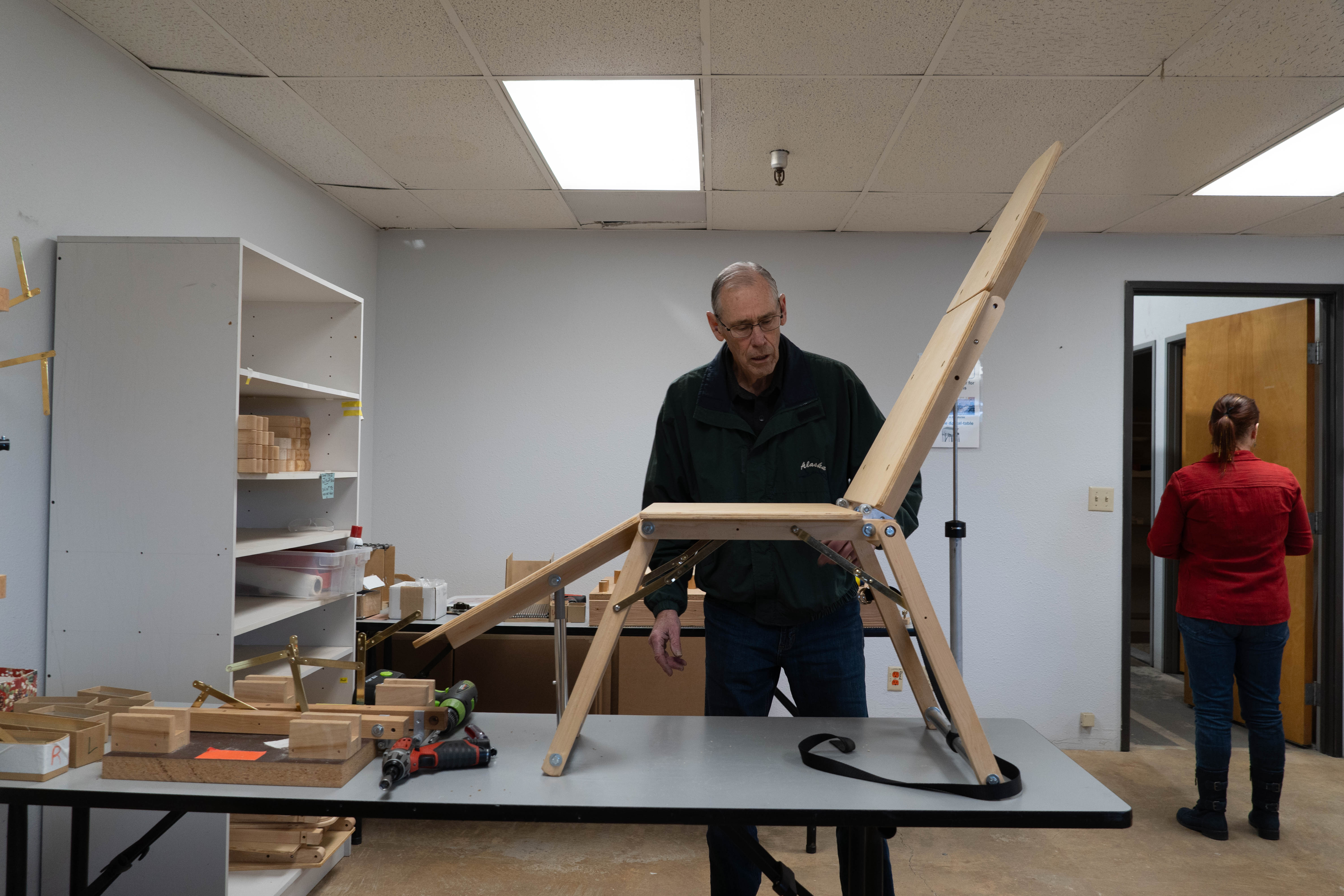
NEWBERG — On Thursday mornings, a group of about eight or nine volunteers gathers in a workspace at Austin Industries in Newberg. They run belt sanders over hardwood planks, assemble hinges, and bolt together a three-piece dental chair designed to fold flat, check as airline baggage, and set up fast enough that a dentist in Nepal or Guatemala can focus on patients rather than equipment.
The chair is called the TotaChair — a nod to “tote-a-chair.” It weighs 25 pounds, something project lead Daniel Burns demonstrates by lifting the chair easily from the assembly table to the inspection table with ease.
The project traces back to 2009, when the late Ken Austin, co-founder of A-dec, the largest dental equipment company in North America, wanted to create a lightweight mission chair that would give patients and providers more comfort than other options on the market. Austin understood the problem intimately: field dentistry in remote locations demands equipment that can survive rough travel and still function reliably once it gets there.

He designed the chair himself, later transferring ownership rights of the design to the Rotary Club of Newberg Early Birds.
“It was his gift to the Rotary Club, to our club — Rotary clubs around the world,” said Burns. “This is our unique project.”
Burns traces the hands-on work back to around 2009, when a small group began building chairs in Austin’s home shop. By 2011, the club had a website and was logging buyers.
“One of the very first projects — a big project — 60 chairs went out for a big event,” Burns said. “That was before our online store went live. There was a real need out there.”
Since then, the club has sold more than 500 chairs. Gross receipts over the life of the project approach a quarter of a million dollars, Burns said. All proceeds flow to the Newberg Early Birds Foundation, which funds local and international brick-and-mortar projects, supports community initiatives, and has helped maintain a sister club relationship with a Rotary club in La Plata, Colombia.
The chair currently sells for $650 per unit, including a carrying bag. Replacement parts are available separately through the club’s website.
The Supply Chain Behind the Chair
The TotaChair may look simple — three sections, a folding frame, and a handful of brackets — but building it draws on a network of local businesses and institutions that donate materials and labor.
Hardwood for the chair’s surfaces comes from Hardwood Industries in Sherwood. Pacific Metals in Tualatin has donated steel tubing — roughly $1,300 worth in recent contributions, Burns said. A-dec, Austin’s original company, donates belts for sanding and boxes for shipping. A.R.E. Manufacturing manufactures the backing rod that holds the chair upright. George Fox University engineering students designed a precision template used during assembly, which Burns said has been a meaningful contribution.

Recently, Newberg High School’s Tiger Manufacturing was brought into the supply chain as they were awarded a $20,000 grant from the Newberg Early Birds Rotary to help purchase additional equipment.
The design has evolved over the years. Early versions used different surface materials, and a recurring issue with a folding mechanism was eventually solved by a club member with an engineering background. Burns described the iterative process as something the group has grown accustomed to.
“It was a big joke among all of us — Ken’s got another change,” Burns said of Austin, who died in 2019. “We’ve had two or three different generations before this.”
Who’s Buying — and Where the Chairs Go
The club’s two largest buyers are Loma Linda University’s dental school and Dr. Gayle Fletcher, a Texas dentist who leads recurring mission trips to a base in Guatemala and has purchased nearly 30 chairs.

A dentist who took a TotaChair to Nepal described it as the best portable option his team had on the trip, noting its quick setup and adjustability for patients. Another user, Doyle Nick DDS, MS, credited the chair’s design for allowing good clinical ergonomics, letting providers remain healthy and productive in the field.
Club members meet on Thursday mornings after the Newberg Early Bird Rotary weekly meeting to fabricate and assemble the chairs, with tasks ranging from dipping parts in polyurethane to building the leg assemblies. Burns said roughly 60 to 70 percent of the club’s 60 members have participated at least once, though a core group of eight or nine shows up consistently.
“Believe it or not, we’re actually working,” Burns said with a laugh during a recent build session.
Looking Ahead: Inventory Complete, Marketing Plan Needed
The club expects to finish building its current inventory batch by the end of March. After that, Burns said the focus will shift to something outside the woodshop: marketing.
The club recently launched a new website at totachair.com with e-commerce functionality. Burns said the next step is building a distribution and outreach strategy to reach mission dentists more broadly — including a potential introduction to a dental organization with an estimated 250,000-member network.
“We’re looking for somebody — an unpaid volunteer — that would be willing to help put together a comprehensive marketing plan,” Burns said. “We’re looking for a salesperson.”
The club has an introduction pending through a local university contact to explore additional outreach channels. Burns said anyone with marketing or sales experience interested in volunteering with the project can reach the club through totachair.com.

For more than a decade, dentists have used the TotaChair on mission sites, and it continues to hold up to the demands of field work. For the volunteers in the Austin Industries shop every Thursday, that durability is the point — and so is the story behind it.
“It’s fun to think about the dentists who are on a mission somewhere doing this,” Burns said. “Vicariously, we get to do some dental work through them.”
Learn more at totachair.com