NEWBERG, Ore. — Facing declining enrollment and uneven class sizes across its elementary schools, the Newberg-Dundee School District is weighing boundary changes, grade reconfigurations, and potential school closures — decisions district leaders say are driven by long-term financial concerns.
Get These Stories First, Right in your Inbox
We send out a FREE weekly newsletter featuring the previous week’s biggest stories, upcoming events, and other local happenings. Our email newsletter is the first to know!
“The hard part is: we’re in a really good spot right now, academically,” said Superintendent Dave Parker. “I’m talking to parents who don’t really see the problem, because the kids are getting more attention, and graduation rates were just announced at 92.6%. So things are good right now, but how do we maintain it in the long term?”
Enrollment is declining and projected to continue falling through at least 2030, according to a report presented by Parker. The district is graduating more students than are entering kindergarten, and four elementary schools now have two or fewer classroom sections at multiple grade levels, creating staffing instability and difficult trade-offs.
Parker said the district’s decline is steeper than that of nearby districts in Sherwood, West Linn, McMinnville, and Tigard-Tualatin.
“Many districts around us have lost 8% to 10% of their enrollment,” he said. “We’re at 18%.”
He attributed the drop broadly to declining birth rates and, more specifically, at the local level, to the 2021 school board controversy and families choosing to “make other choices,” which he said limits the district’s ability to grow out of the problem.
District leaders say the most immediate risk is class-size volatility. Without structural changes, projections show more than 40% of elementary classrooms could exceed 30 students — a scenario Parker said the district avoided this year by adding staff, but which district materials describe as unsustainable.

Parker described a recurring challenge: staffing decisions are made in the spring based on enrollment projections, with a target of about 23 students per class. That number balances teacher workload with budget constraints.
A common scenario, he said, is that enrollment shifts over the summer push a class beyond capacity. A classroom can quickly exceed 31 students, forcing a difficult choice: split the class and add staffing costs, or keep the larger class size and risk reduced student attention and teacher burnout.
The budget remains a primary consideration. The district recently emerged from a nearly $3.7 million shortfall in 2024, before Parker was hired as interim superintendent. The school board requires a 7% year-end fund balance, meaning roughly $4.2 million of the district’s $60 million general fund budget should remain in the fund at the end of each year to manage financial uncertainty.
At the same time, Parker emphasized that the current K-5 neighborhood school model is working for students and would be maintained if funding allowed.
“There’s something to be said about neighborhood integrity,” Parker said. “Edwards and its neighborhood, for example. They love their school, and their school loves them. All of our schools have devoted followings, and that neighborhood — that’s part of what makes Newberg Newberg.”
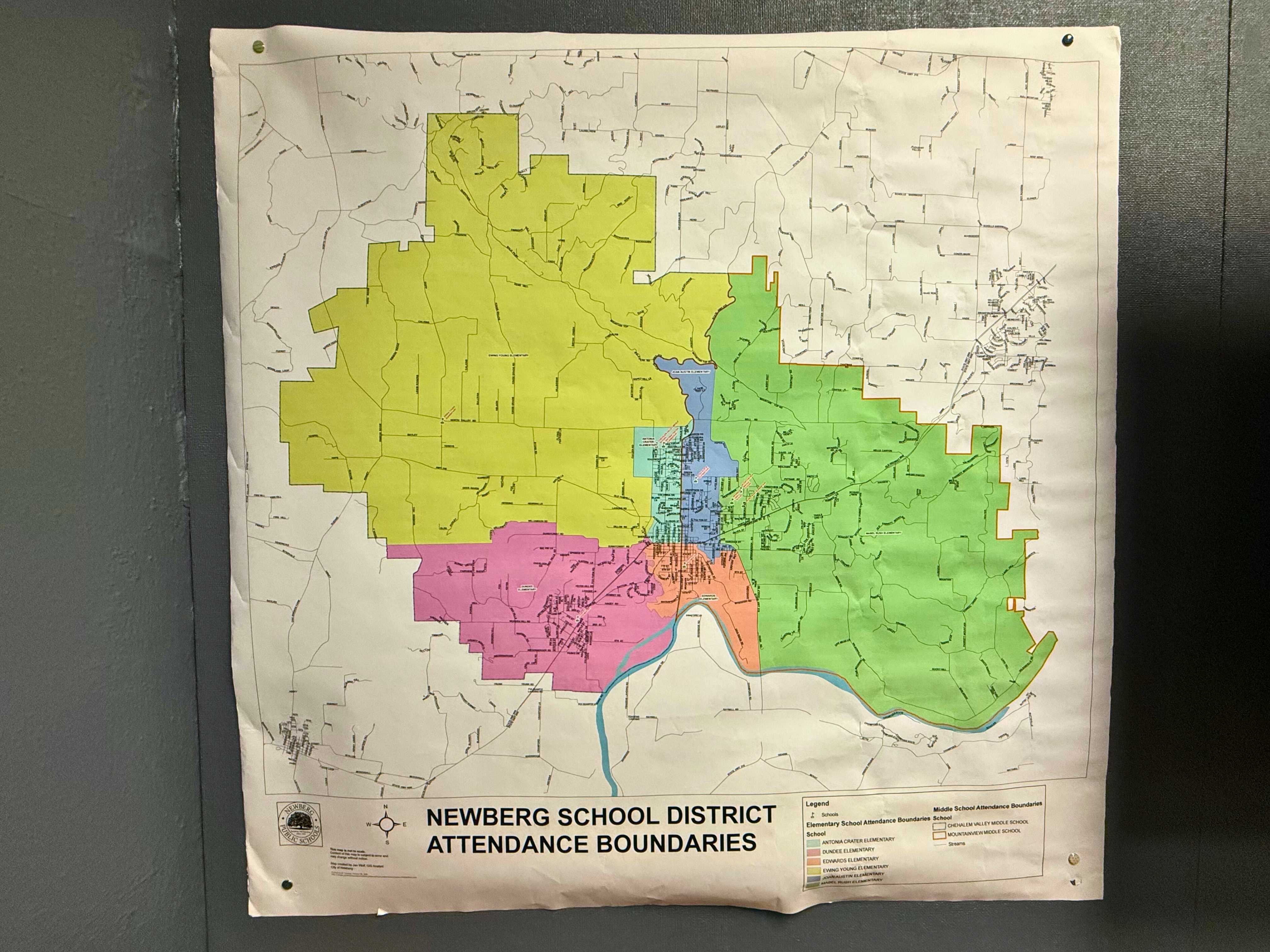
The Boundary Committee — formed to review enrollment patterns, attendance boundaries, and possible reconfigurations — has considered a range of options, including boundary adjustments, a K-2/3-5 split, a K-4/5-6 mode, and potential school closures.
Its guiding criteria include student learning, community input, class-size balance, safety and transportation, neighborhood integrity, financial sustainability, and future growth.
Committee members agreed early that enrollment decline is the core issue and that boundary changes alone may not solve it, according to a summary included in the presentation.
The committee’s primary recommendation would restructure the district into K-4 elementary schools, a grades 5-6 intermediate school, and a grades 7-8 middle school. The proposal also recommends closing Ewing Young Elementary School and converting Edwards Elementary School into a dual-language-only building. English-only Edwards students would be reassigned to Dundee, Crater, and Joan Austin elementary schools.
District estimates show the plan could save about $2.1 million, though the presentation notes additional reductions would still be needed to meet budget targets.
Parker stressed in both the presentation and an interview that the recommendation is not a final decision.
“Nobody in that room loved this,” he said. “Every option we have has big trade-offs, and none of them are as good as where we’re at. All of them will have substantial impacts on education.”
The district has also adjusted its implementation timeline, moving any major changes from fall 2026 to fall 2027. District materials say the shift is intended to allow sufficient lead time “to implement major changes responsibly if revenue does not increase,” while keeping options viable.
Another major consideration is whether the district should pursue a local option levy. A levy is a voter-approved property tax that supplements state school funding and is assessed per $1,000 of assessed property value for five years.
While levy funds could be used for a range of purposes, Parker said any proposed levy would be restricted to paying classroom teachers to avoid school closures.
“Accountability is paramount right now,” Parker said. “You’ll see we’ll make it clear — no administrators, just teachers. It’s about building financial stability. We’d put it in a separate account and have the Citizens Budget Committee report quarterly so everyone can see how the money is spent.”
The presentation frames the decision this way: With additional revenue, the district could maintain its K-5 neighborhood school model with stable class sizes. Without it, restructuring may be necessary “to create operational flexibility and avoid unacceptable class sizes or widespread blended classrooms.”
If approved by the school board, the levy would go before voters in the May 2026 special election. The next Newberg-Dundee School Board meeting is scheduled for Feb. 10 from 6 to 8 p.m.